

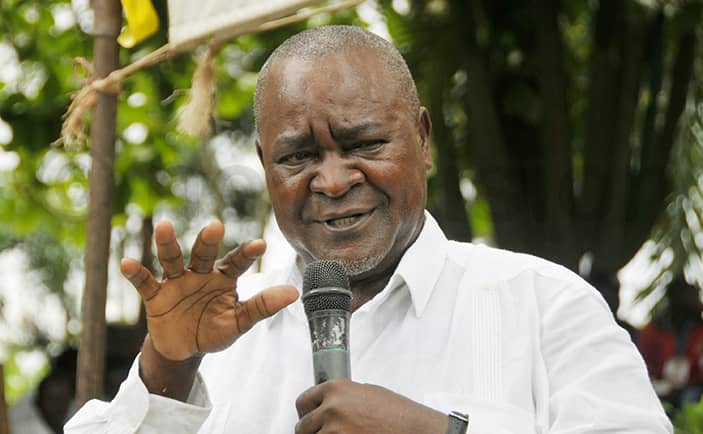
The political landscape of Wakiso District is heating up as former Vice President Gilbert Bukenya, now Presidential Advisor on Environment, has thrown his weight behind President Museveni, urging residents to vote for him in the upcoming election.
Speaking at an undisclosed location in the district, Professor Bukenya’s endorsement comes amidst an intense campaign season and growing debate over the prospect of a seventh term for the President.
His central message to Wakiso voters focuses on the promise of continued development and the urgent need to complete long-standing infrastructure projects, particularly the poor road network affecting many areas.
Professor Bukenya’s call reflects the significance of the election for a district grappling with rapid population growth and heavy pressure on services.
He framed his support around unfulfilled presidential pledges, saying Museveni’s re-election offered the most direct route to seeing those promises realised.
“If the people of Wakiso re-elect President Museveni, it will facilitate the completion of the projects he promised, particularly in uplifting the living standards of our people and improving the delivery of government services in this area,” Bukenya said.
He pointed to the everyday challenges caused by the district’s infrastructure gaps, arguing that better roads, improved livelihoods, and more efficient government services hinged on maintaining the current leadership.
His message tapped into widespread frustration over poor access to essential services and the need for greater economic opportunity.
Infrastructure dominated his remarks. He highlighted the dire state of roads in areas such as Nakawuka and Ssentema, describing the daily hardships they impose and warning of further delays should political change occur.
“The poor road network, especially in areas like Nakawuka and Ssentema, requires immediate attention,” he said. “If the people of Wakiso choose a different leader, it would take longer to complete these projects.”
Wakiso’s choice as the focus of Bukenya’s endorsement carries weight. As one of the most populous districts in the country and deeply intertwined with Kampala’s urban and peri-urban expansion, it remains a strategic electoral battleground.
Any endorsement within the district has potential to shape voting behaviour and influence national outcomes.
Bukenya’s position as Presidential Advisor on Environment gives him a national platform, but his past role as Vice President lends his words additional authority.
His endorsement signals both political loyalty and confidence in the continuity of the current administration’s development agenda.
His stance also comes against the backdrop of a broader national debate. This will be the seventh time President Museveni seeks office since taking power in 1986.
While his tenure has seen notable development, it has also drawn criticism over corruption, human rights concerns, and the narrowing of political space. Bukenya’s endorsement is therefore likely to generate both praise and condemnation.
Opposition figures continue to promote their own development agenda, rooted in improved governance, tackling corruption, and expanding economic equality.
Their message stands in sharp contrast to the incumbent’s appeal for continuity and stability.
Bukenya’s intervention sharpens the choice before voters, urging them to consider what he portrays as the risk of stalled progress if leadership changes.
By grounding his appeal in the daily realities of Wakiso’s road network and unfulfilled projects, he speaks to concerns that resonate strongly with local voters.
However, the endorsement may also attract scrutiny. Critics of the current administration are likely to highlight Wakiso’s persistent challenges — inadequate access to clean water, poor waste management, and limited public transport — as evidence that the development agenda has not delivered as promised.
Questions surrounding corruption, transparency, and the allocation of development funds may further shape voter perceptions.
In conclusion, Professor Bukenya’s endorsement of President Museveni marks a significant moment in the run-up to the election.
His emphasis on infrastructure, continuity, and the completion of long-promised projects places Wakiso’s pressing needs at the centre of the political debate.
As the electorate weighs competing visions for Uganda’s future, the coming weeks will determine whether his message of continuity resonates more strongly than calls for change.
